Tax

Tax compliance is a critical part of running a successful business. Understanding your obligations helps you avoid penalties and maintain financial stability. This section provides practical guidance on key areas such as Reverse Charge VAT, anti-tax evasion and making tax digital.

HMRC Announcement 12 November 2020

Contractors employed in Construction work must register with CIS. The CIS Scheme covers most construction work and contractors who pay subcontractors must be registered.
 
As of 6 April 2021 the CIS Scheme changed, as follows:

  • CIS Set Off Amendment Power
  • Cost of Materials
  • Deemed Contractors
  • CIS Registration Penalty

In brief this means, that from the 6 April 2021:

  • Where HMRC is dissatisfied with the evidence provided to support a set off claim by an employer against his liabilities, then HMRC will amend the CIS deduction figure on the EPS.
  • Only materials directly bought for that specific contract will be allowable as a reduction in the gross payment in order to determine the tax liability.
  • The time periods currently set to review whether a non-construction business whose spend on construction exceeds the £1m average threshold must shorten and a review of their tax position must occur on a more regular basis.
  • The scope for HMRC to inflict financial penalties to any person deemed influential in the decisions as to how to declare CIS liabilities is being widened.

HMRC’s explanation and summary of these changes can be found on the HMRC’s website search: Changes to tackle Construction Industry Scheme abuse.


Overview

The Construction Industry Scheme (CIS) sets out the rules for how payments to subcontractors for construction work must be handled by contractors in the construction industry and excellent information is available from the HMRC website. 

The tax authorities provide the industry with a number of on-line support services. For a full introduction to how CIS may affect you, please visit the HMRC website. 

HMRC provide a guide to CIS for Contractors and Subcontractors (Re: CIS 340). 

While considering Tax Status, it is important to check the employment status of your subcontractors. You can do this by completing the on-line status indicator (ESI) found on the HMRC website. 

Most VAT-registered businesses with a taxable turnover above £85,000 need to follow the rules for Making Tax Digital for VAT. 

Companies are also required to keep accounts and records digitally and use HMRC approved software to make their VAT returns.

HMRC have produced a series of guides and Members are advised to periodically visit HMRC’s website to ensure they are aware of the most recent announcements etc. Click here for HMRC's series of guides >

VAT on construction

Sales may attract a sales tax, in the UK we call this tax VAT.

Works, in the variety of locations and for a variety of customers may attract a number of different sales tax rates, from exempt, through zero rated and partial or lower rated to a standard rating. The HMRC expects every business to know which rate is applicable if  necessary to prove the rate charged to their customers is correct.
 It is important that if there is any doubt then HMRC’s guidance must be sought and reliance on any direction must only be made on written evidence.

VAT, at zero rate, is charged on the construction of new buildings, provided the supply is for a social purpose e.g. new houses, dwellings and buildings with a charitable status. 

VAT, at zero rate, is charged on ‘approved’ alteration work on “protected buildings”. Approval in this context refers to its VAT status not on some Planning or Building Regulations application. Alteration, in this context, means that a building’s fabric (walls, internal surfaces, floors, stairs, windows, doors, plumbing and wiring is changed in a meaningful way. 

VAT, at the standard rate, is charged on repair or maintenance work of any “protected building”. VAT, at the Reduced Rate, is charged on work which is altering an empty residential building where a change of use is envisaged. VAT, at the standard rate, is charged on all other construction work. 

VAT is a very complex area of law and specialist advice may be required where works are being considered which do not clearly fall into a specific category.

The following is given by way of example: The shell of a building (structure and cladding) used in new construction is considered, for VAT purposes, as ‘alteration works’ if at least two walls are retained. ‘Granny annexes’ when sold as part of a dwelling are not to be treated as a separate commodity. A new build annexe to a charitable building would be treated as zero-rated if it has an independent means of access and it could function independently of the original building. Knowledge of these stipulations may may be valuable when tendering a design and build project.

The HMRC’s website has guidance under ‘Buildings and Construction’ or try  the www.nibusinessinfo.co.uk which also has useful information.

Certain sales invoices will be subject to new VAT provisions. VAT Reverse Charging will apply to the following contracts.

• Those where the participants are subject to CIS.
• Those where the end-user (Employer) is retaining the built asset for their own use.
• Those where ‘sales’ comprise labour, material and/or plant.
• Those that may include an element of excluded sales but where those excluded items form part of the whole.

HMRC has produced an introductory webinar, Download the following flow-chart and then watch the first 30 mins of the webinar, the link follows:

       1. Appendix one – HMRC’s Flowchart – to determine whether VAT reverse charging 
       applies and the elements of the process that need managing.

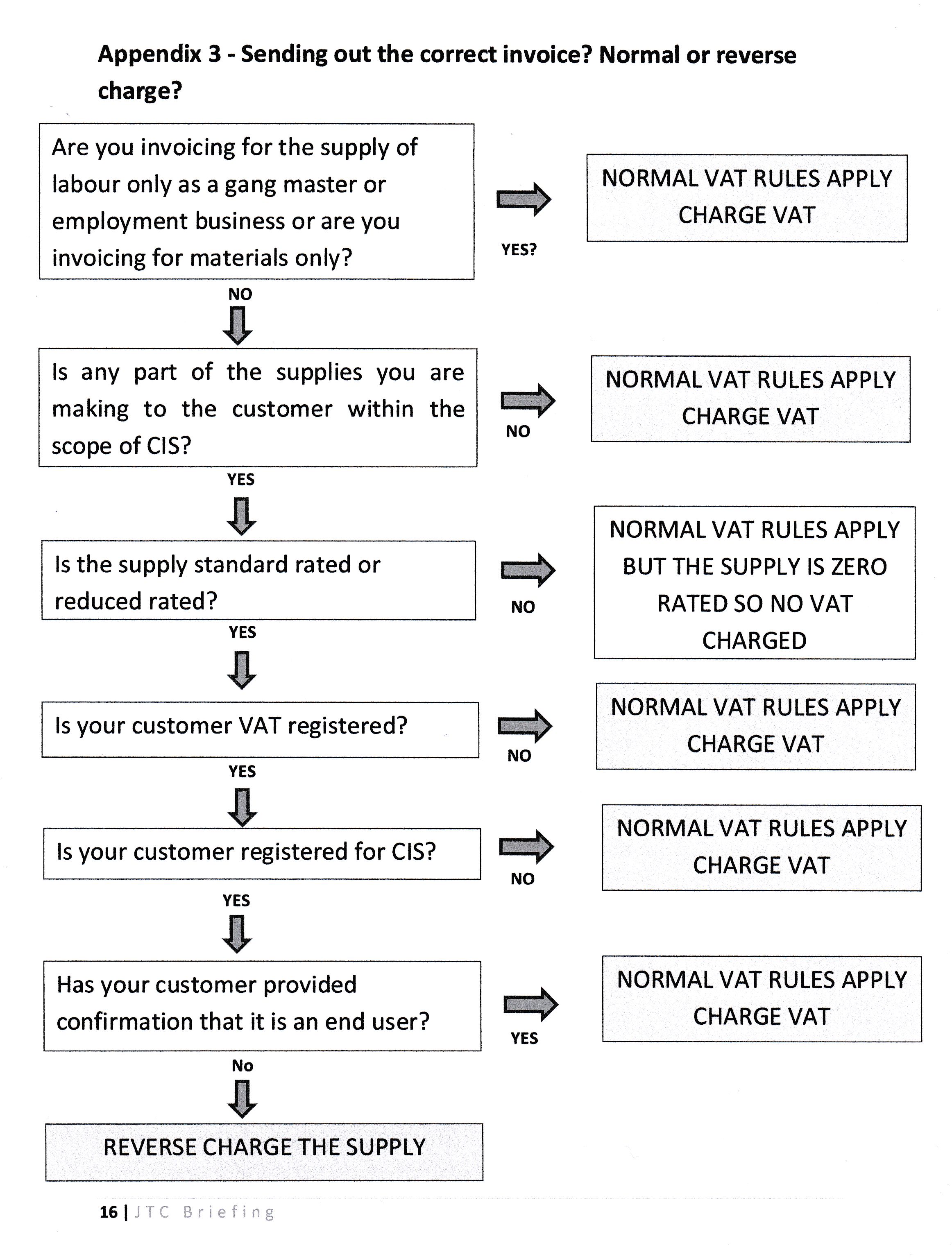
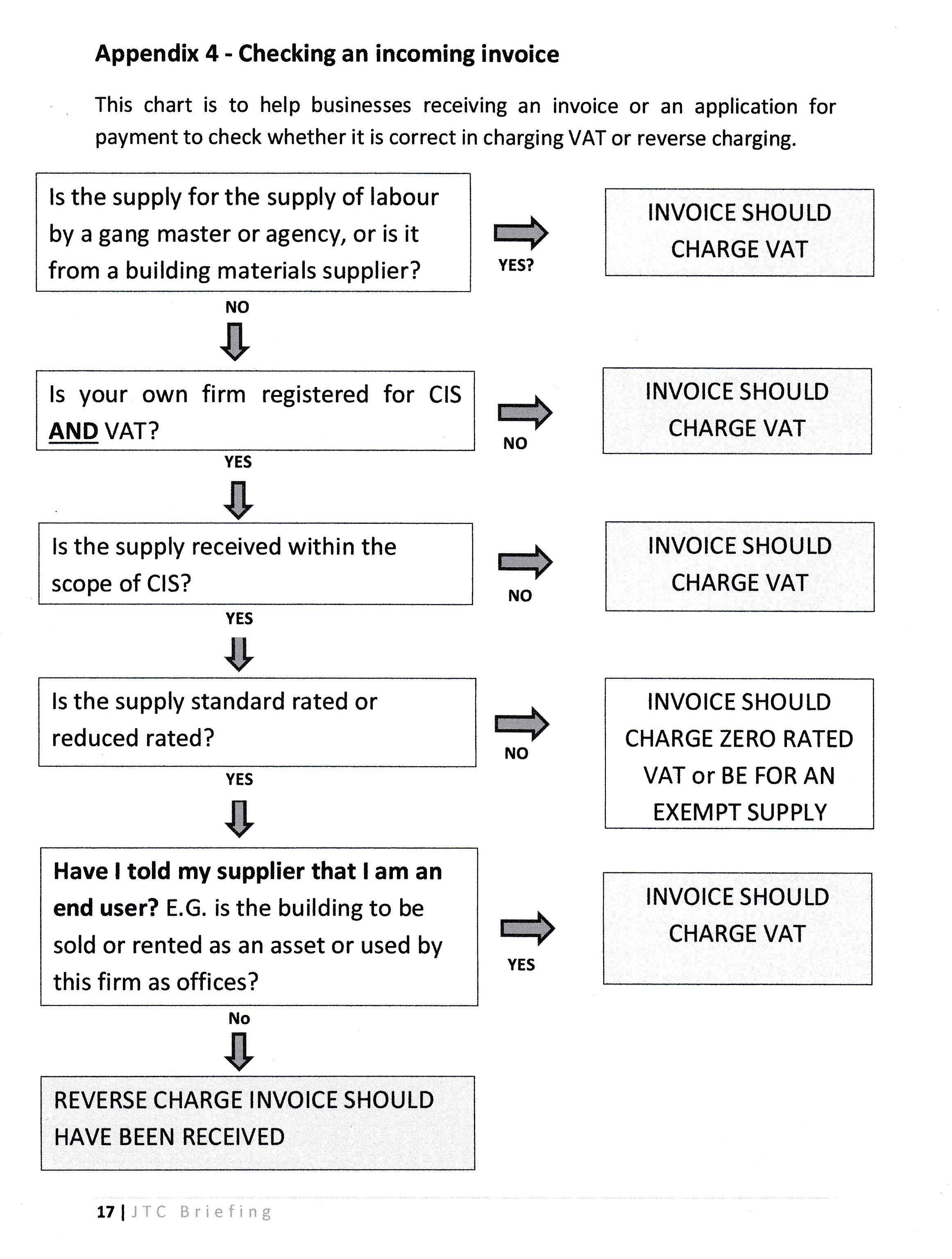
Contracting Members who are employed on a self-billing basis will have the reverse charging applied to their applications. The methodology as to how to mange outgoing and incoming invoices is illustrated below:-

       3. Appendix 3 – Flow Chart – issuing a correct invoice.
       4. Appendix 4 – Flow Chart – checking an Incoming Invoice.

VAT Reverse Charging will NOT apply to the following sales / contracts:

  • Sales entirely consistent of supply-only assets.

  • Sales entirely comprising of the installation of security systems (burglar alarm) closed circuit television and public address systems.

HMRC's approach to mixed supplies: 

The legislation is designed so if there is a reverse charging ‘element’, in a supply, then the whole supply will be subject to Reverse Charging. A significant amount of communication will be required.

If in doubt, provided the recipient is VAT registered, and the payments are subject to CIS, it is recommended that the reverse charge should apply.

Download our guidance notes and templates 

Developed by our Legal & Business experts to help ensure you remain compliant with tax.