
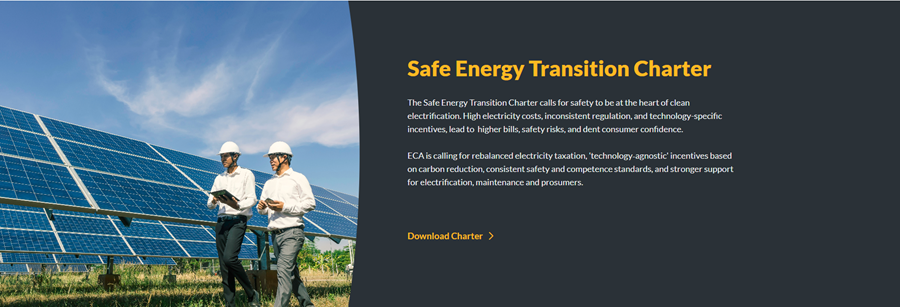
ECA’s Safe Energy Transition Charter sets out practical policy actions to speed up low carbon adoption while keeping installation safety and competence at the centre of delivery.
Introduction
The energy transition is moving in one direction, towards clean electrification. In the UK, despite hotly debated political and media rhetoric, the evidence is clear, renewable generation is an essential part of the mix that keeps bills stable and supports the safe, reliable electricity we all depend on.
For ECA Members, this shift is already creating opportunities, from new connections and upgrades through to EV charging, heat , solar, battery storage and smart controls. ECA’s role is to ensure that, as change accelerates, safety is never compromised.
Energy and supply chain security
In 2025, the UK’s Joint Intelligence Committee set out the national security risks created by climate disruptions around the world. This included the effect on oil, materials, and food supply chains. The latest war in the Middle East has sharpened the security case for reducing fossil fuel dependency. The UK is particularly exposed to global volatility as we rely heavily on imported oil and gas and import 48% of our food. We are currently seeing that fragility play out in real time as energy prices spike and supply chains come under strain.
A distributed, small-scale renewable generation system provides a strategic defence. Large scale generators can be vulnerable to single, catastrophic failures, subjecting swathes of the country to power outages. As Russian attacks on Ukraine infrastructure have shown, large power plants can be disabled by a single strike. By contrast, an equivalent amount of energy generated in dispersed renewable sites would require many separate attacks to disable.
Economic imperative
A safe energy transition is about more than decarbonisation, it is about creating an economically resilient and stable business landscape. The CBI estimates that maximising green growth opportunities could add £37–£57 billion to UK GDP by 2030. A survey of UK business leaders also conducted by the CBI, show the majority are committed to reducing carbon emissions, seeing it as a commercial imperative driven by competitiveness and cost savings. Many are planning and investing in low carbon, digital solutions to future proof their businesses, without waiting for Government interventions. The direction of the market is clear.
Events such as the high profile Innovation Zero World Congress, taking place in London this week underline just how fast this agenda is moving. Government is moving into an implementation phase and a renewed focus on energy security and sustainable growth.
The focus on delivery is why ECA has launched the Safe Energy Transition Charter. The Charter is a practical set of policy asks to encourage increased adoption of low carbon technologies which embed safe installation as a principle.
Cleaner, cheaper electricity
The Climate Change Committee’s 7th carbon budget found reducing the cost of electricity would be the single biggest impact on reducing carbon emissions and increasing adoption of electrical installations.
Renewables are already improving resilience and putting downward pressure on costs, even if that is not always visible on bills. Volatility in fossil fuel prices can mask the underlying trend, as more renewables connect to the grid, they prevent the worst of price spikes.
- In January this year, 61% of the UK’s electricity came from zero carbon sources.
- Last year, renewables supplied at least half of UK electricity on around a third of days.
- Renewable generation is typically the lowest cost option for new power, and system benefits increase as more clean capacity connects.
A key issue is the link between wholesale gas prices and the electricity price paid by consumers. The Government has recently proposed measures to reduce bills, including options to decouple wholesale gas and electricity pricing.
For consumers, electricity costs around four times as much as gas. It is the highest in Europe. The reason is an outdated and complex set of levies which leave energy taxation unbalanced. Many of these charges were designed when electricity was generated by burning fossil fuels, which, as shown earlier, is largely out of date. While the Government has recently removed the ECO levy, any savings on bills are being eroded by the global energy crisis and higher oil prices.
ECA have been making the case for reviewing energy taxation to bring it to parity with gas for the last five years. The Charter reinforces this point.
Electrification of transport
Electric vehicles are a major driver of rising electricity demand, supported by policy incentives and rapidly expanding charging infrastructure. But for many people the market still feels confusing, and the experience is not yet consistently simple across charge point operators. If we want transport electrification at scale, the technology must be easy to adopt, and it must be safe. Charge point installations should be carried out by qualified electricians.
Grid capacity
Much of the UK’s grid was built for a different era. Major upgrades have lagged behind the pace of change in generation. In the recent Spring Statement, the Chancellor announced financing for grid upgrades and infrastructure improvements. Delivery at this scale will require a highly trained workforce. In particular high-voltage jointing and cabling work will provide opportunities for ECA Member firms.
ECA is calling for consistent training and competence standards in safety-critical environments. This includes equivalent safety, product, and competence standards for England, Wales and Northern Ireland.
Prosumers
As rooftop solar, battery storage, EV charging, and smart controls scale up, more consumers are becoming “prosumers”, both producing and consuming electricity. Done well, this can reduce peak demand, cut costs, and make the system more resilient. Done badly, it risks inconsistent safety, poor-quality installations and a loss of consumer confidence . It is essential to get advice from a qualified electrician who can assess the property and give independent advice on the best technology for efficiency and cost saving.
Safety - the enabling condition for the energy transition
Electrification touches every part of daily life, from how we heat homes to how we travel and how businesses operate. That means safety cannot be treated as a compliance add on. It must be built into system design, workforce planning, product standards, and maintenance schedules .
The energy transition is inevitable, whether it is safe, affordable and resilient is a choice. If we align investment in clean electricity with grid delivery, workforce competence and consistent safety standards, the UK can reduce exposure to fossil fuel volatility while building a modern, dependable electricity system that people trust.
If we want a transition that the public can back, we need to get the fundamentals right; safety standards that keep pace with technology, competent installation and maintenance, fairer energy taxation, and incentives that reward real carbon outcomes. That is the purpose of ECA’s Safe Energy Transition Charter.