
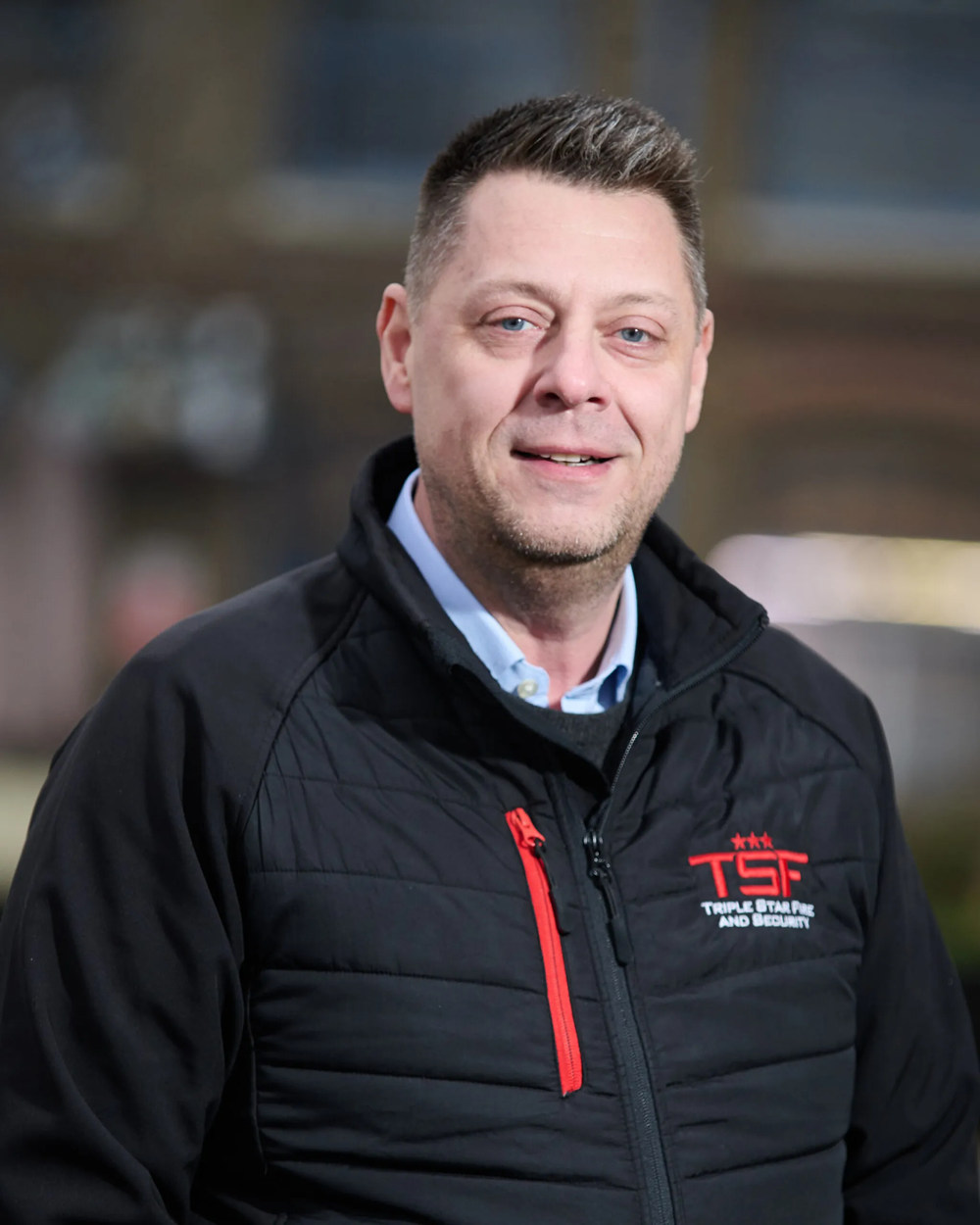
What does it mean to you to be Chair of the Fire & Security Association?
To be Chair of the FSA is both a privilege and a responsibility. This Association represents a sector that protects lives, property, and critical infrastructure every single day. Being entrusted to help lead that collective voice - on behalf of our members and the wider industry - is something I take extremely seriously.
For me, the role is about stewardship: safeguarding the reputation of our sector, championing professionalism, and ensuring that the FSA remains relevant, respected, and influential in a fast‑changing world.
Can you tell us a bit about your background and professional journey?
I’ve spent the majority of my professional career in the fire sector, working across operational, commercial, and leadership roles. That journey has given me a ground‑level understanding of the realities our members face - from compliance and standards, to skills shortages, technical innovation, and customer expectations.
I’ve been fortunate to work with excellent people throughout my career, and that experience has reinforced my belief that this industry’s greatest strength is its people - their expertise, integrity, and commitment to protecting others.
What are your priorities for the next five years?
My key priorities are focused on relevance, professionalism, and influence.
Over the coming years, I want the FSA to:
- Be the first port of call for members seeking guidance, support, and representation
- Champion standards, competence, and ethical practice across both fire and security
- Support the industry through technological change, including digital systems and smarter integration
- Actively address skills, training, and succession planning
- Strengthen the FSA’s voice with government, regulators, and stakeholders
The next phase must be about ensuring the Association evolves at the same pace as the industry it represents.
What have you done in your first 150+ days since becoming FSA Chair?
My early focus has been on listening. I’ve spent time engaging with council members, committees, membership and partners to understand what is working well and where we can improve.
What changes have you seen in the fire and security services industry over the years?
The industry has become more complex, more accountable, and more technologically driven. There is greater scrutiny than ever - from regulation, from clients, and from society at large - and rightly so, given the critical nature of the work we do.
We’ve also seen increasing convergence between fire, security, and digital technologies, alongside rising expectations around competence, documentation, and transparency.
What do you see as the biggest opportunities and challenges facing the industry right now?
The biggest opportunity lies in professionalisation and innovation - demonstrating the value our sector brings through competence, quality, and trusted delivery.
Equally, the challenges are significant:
- Skills and recruitment shortages
- Keeping pace with regulation and standards
- Ensuring consistency and competence across the supply chain
- Managing the impact of rapid technological change
How we respond collectively will define the industry’s future reputation.
How would you address these challenges in the industry?
If we’re honest, many of the challenges in the fire and life safety industry are not new - and in some cases, they’re self-inflicted.
We continue to operate in a fragmented environment where responsibility is too often blurred. Designers are left to interpret requirements that should have been clearly defined at the fire strategy stage. Installers are expected to deliver systems without consistent, project-specific direction. And meanwhile, different disciplines are working in silos, all assuming someone else has taken ownership of the critical decisions.
The result? Over-designed systems in some areas, under-protection in others, and a lack of consistency that simply shouldn’t exist in a life safety environment.
One of the biggest issues remains competency - or more accurately, the lack of a universally enforced standard of it. There are excellent people in this industry, but there are also too many routes that allow individuals or organisations to operate without the depth of knowledge required. We’ve normalised a situation where life safety systems can be influenced by people who do not fully understand the consequences of their decisions.
The industry doesn’t need more guidance - it needs clear accountability and enforced standards.
Equally, we need to stop tolerating vague or incomplete specifications. A fire alarm system category, for example, is not a design preference - it’s a fundamental life safety decision that should be determined through a competent fire risk assessment. Yet designers are still routinely expected to “fill in the gaps”. That is not just poor practice; it introduces unnecessary risk.
Technology isn’t the problem - in many ways, it’s ahead of us. The issue is how inconsistently we apply it. Integration, smart systems, and advanced diagnostics are all positive developments, but without proper structure and validation, they can create as many problems as they solve.
Ultimately, the industry needs to shift from a culture of interpretation to one of definition. Clear responsibility, properly qualified professionals, and well-defined design parameters from the outset would resolve a significant proportion of the issues we currently face.
Do any of the opportunities and challenges differ between the fire and security sectors?
While fire and security face many shared challenges, there are differences. Fire is increasingly driven by regulation, compliance, and life safety risk, while security is often influenced by evolving threats, technology, and integration.
However, both sectors depend on competent people, robust standards, and trust - which is why alignment and collaboration are more important than ever.
Given the life-critical nature of electrical work, should the profession now be formally protected, and what would it take to make that a reality?
Put simply - yes, it should. And the fact that it isn’t already raises serious questions.
We are talking about systems that people rely on to stay alive: fire alarms, evacuation systems, life safety electrics. Yet in many cases, the term “electrician” remains loosely defined and inconsistently regulated. Compare that to other professions where public safety is at stake - structural engineers, gas engineers - and the gap becomes obvious.
The current model relies too heavily on voluntary certification and client awareness. That’s not enough. In a life safety context, competence should not be optional - it should be enforced.
Formal protection of the profession would be a major step forward, but it needs to be done properly. This isn’t about creating barriers for the sake of it - it’s about ensuring that anyone working on life-critical systems has the appropriate level of training, experience, and oversight.
At a minimum, this would require:
- A clearly defined competency framework, covering both general electrical work and specialist disciplines like fire detection and emergency systems
- A protected or licensed status, meaning only qualified and registered individuals can undertake specific categories of work
- Mandatory third-party certification, not as a badge of quality, but as a baseline requirement
- And, critically, real enforcement - because regulation without enforcement achieves very little
There will always be resistance, particularly around cost and accessibility. But we have to ask a simple question: what level of risk are we willing to accept?
Because right now, the system allows too much variation in quality - and in a life safety environment, that variation can have serious consequences.
The reality is that the industry has evolved, the risks have increased, and the regulatory landscape has shifted significantly since Grenfell. The way we define and control competency needs to reflect that.
Formal protection isn’t about prestige - it’s about responsibility. And in a profession where lives are directly affected by the quality of work delivered, it’s becoming increasingly difficult to justify why it hasn’t already happened.
What role should FSA play in helping the industry respond to these opportunities and challenges?
The FSA should act as a trusted anchor for the industry:
- Promoting best practice and ethical standards
- Providing clear guidance and authoritative commentary
- Supporting skills development and competence pathways
- Acting as a united voice with regulators and policymakers
Most importantly, the Association must continue to be member‑led and member‑focused.
What advice would you give to someone considering a career in the fire and security services industry?
This is a career where what you do genuinely matters. My advice would be to commit to learning, take competence seriously, and choose to work for organisations that value professionalism and integrity.
There are few industries where you can combine technical skill, responsibility, and real societal impact in the way this one allows.
What’s your favourite thing to do when you’re not working?
Time away from work is important. I value time with family and friends and making space to recharge. A clear head and perspective are essential if you want to lead effectively.
What’s the best piece of advice that you have been given in your career so far?
My advice would be this: never build your career on being the cheapest option. This is an industry where competence, integrity, and professional judgement must always come first.
Fire and security work carries real responsibility - people’s lives, livelihoods, and trust depend on it. That means doing things properly, investing in skills and training, and being confident enough to stand by your expertise, even when commercial pressures push in another direction.
It is also important to recognise that it is okay to say no. If a project cannot be delivered correctly, compliantly, or sustainably within the available budget, then walking away is often the most professional decision you can make. Long‑term trust and reputation are far more valuable than short‑term work that forces compromise.
The most respected individuals and businesses in this sector are not those who race to the bottom on price, but those who consistently deliver quality, competence, and confidence. If you focus on doing the right thing, the right way, you build a career — and a business - that lasts.
What key message do you want FSA Members to take away from this article?
The FSA exists for its members, and its strength comes from your engagement, professionalism, and shared commitment to raising standards across our industry.
Together, we have an opportunity - and a responsibility - to shape the future of fire and security in a way that protects lives, builds trust, and leaves a positive legacy for the next generation.